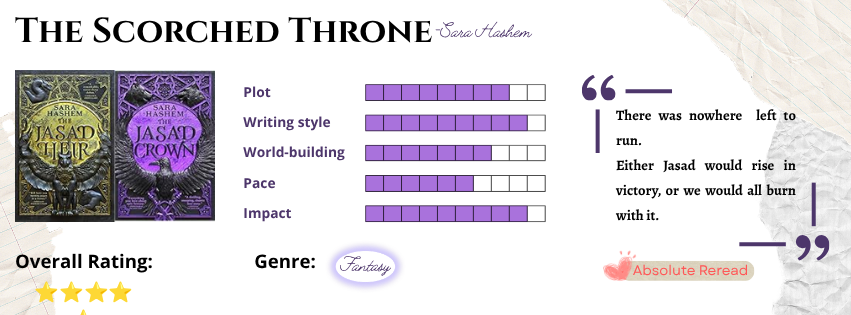
Before we begin...
I picked up this duology expecting a fun Middle Eastern-inspired fantasy.
I closed it emotionally scared.
This review contains:
✦ a ton of spoilers
✦ an unhealthy amount of crying
✦ propaganda analysis nobody asked for
✦ my therapist's future workloadagraph here

1- The Architecture of the World
Everybody loves an Oriental fantasy. It's so easy to reduce it to veils, spices, bustling bazaars, and tales of magic. I think Hashem absolutely nails the setting, and in my opinion there are two main reasons why.First, Hashem writes from an Egyptian background, which frees her from the colonial lens that has shaped so much of the Western imagination of the "Orient." That's not to say a non-Arab author can't write an Arab-inspired fantasy. Of course they can. But, in the words of Sylvia from Mahair:
"Have you considered... that the truly brilliant people are the ones who understand the realities we build were already built for us?"
That quote feels almost meta.
Arin is a character we grow to admire for many of his actions, yet he still stands on the colonizer's side of history for an good amount of the duology. He judges the Jasadis through stories his people have carefully woven, stories that ultimately justify their persecution and attempted genocide.
We're almost tempted to excuse him because... how could he have known?
His worldview was inherited.
Hashem, on the other hand, didn't grow up with a whimsical, exoticized vision of the Orient. She grew up with the memory of what colonialism, occupation, and the longing for liberation have meant across much of the Arab world. That difference inevitably shapes the story she tells.
Just as romance is woven into the French imagination, hospitality into the Mediterranean, or individualism into much of the West, the pursuit of freedom has become a recurring thread in the modern Arab imagination. You can feel that current running beneath every layer of Mahair or Jasad. Sylvia longs to free herself from Hanim, from Nizahl and from the expectations placed upon her as an heir. Essiya fights for the freedom of her people. Even Arin's journey is, in its own way, about breaking free from the narratives he inherited and from his father’s control.
The setting is beautiful, but unlike so many Orientalist fantasies, it isn't built on the aesthetic alone. It is grounded in a history, a memory, and a yearning that make the world feel lived in rather than simply decorated.
2- Legendary Lovers
Help, I’m still at the restaurant.
And I think I’ll be staying there for a while.
Now... this is a little embarrassing to admit, but I'll admit it anyway. I cried in the last few chapters like I have genuinely never cried over a book before. Full-on ugly crying. But I'll save that emotional breakdown for the "The End" section of this review.
For now, let's talk about the love story.
As much as I think this is one of the most beautiful romances I've ever read, I don't actually think romance is the main focus of this series. It feels more like a subplot for most of the story—one that quietly grows in the background until, by the end, you realize it has become one of the emotional pillars of the entire book.
We all loooooove an enemies-to-lovers moment.
But personally? That wasn't what made me absolutely feral.
It was the impossible lovers trope.
They're barely enemies for long. By book two, they're enemies on paper, by title, by duty, by the kingdoms they were born into. But every conversation, every piece of banter, every stolen glance betrays what they refuse to admit out loud. Neither of them says I love you. They don't have to.
The moment losing the other becomes a possibility, both of them are willing to betray everything they were raised to protect.
Arin
"If she dies for them, they will die with her."
"You would choose her over your own kingdom? Over your own family?"
"Yes. I choose her."
"I swear myself to Jasad's Malika. Everything I have is hers to command."
Essiya
"If they killed him, I would bury this mountain in the sea."
How do you even recover from that??
What makes their relationship so compelling isn't that they fall in love overnight. They first learn to respect each other as opponents. Then, being forced to live under the same roof throughout the Alcalah in book one, that respect slowly becomes care.
By book two, they're technically future rulers of opposing kingdoms. Their people expect them to be enemies. History expects them to be enemies.
But they aren't.
They've already seen each other too clearly for that.
Earlier in my review I kind of... took a dig at Arin for believing everything he'd been taught about Jasad and magic. Because, in my opinion, charming smiles and pretty words don't magically erase genocidal tendencies.
Sorry. I said what I said.
That being said...
His redemption arc??
Absolutely insane.
One of the things this book does incredibly well is show how propaganda works. In genocide, and oppression in general, propaganda is what makes cruelty feel reasonable. It's what dehumanizes entire groups of people until discrimination starts feeling like "common sense."
Of course magic is corrupt.
Of course there's magic madness.
Of course the Blood Summit proves they're dangerous and they started it all.
These stories are repeated so often that nobody thinks to question them anymore. They're enough to justify forcing thousands of people to hide who they are, terrified that simply existing will cost them their lives.
But propaganda has one fatal weakness.
It only takes one lie being exposed for the entire structure to begin collapsing.
"The fortress fell before the messenger did.
No—this is not a war.
This is a siege."
That was the first domino.
The moment Arin starts uncovering the truth is the moment he begins turning away from everything his father taught him. And, perhaps for the first time, he allows himself to love Essiya without trying to justify it.
From that point on, our calculated king has exactly one objective:
Keep Essiya alive.
He almost succeeds.
If it weren't for the Awaleen's curse.
And that's what absolutely destroyed me.
He fails.
She disappears.
Watching Arin become a shell of the man he'd grown into, retreating back into that cold, emotionally guarded version of himself, was heartbreaking. He spent two books yearning for her. He yearned for her when they barely knew each other, back in Mirayah. He yearned for her during every impossible moment they managed to steal together.
And he kept yearning for her long after everyone believed she was gone and it was "impossible" for her to come back.
I put impossible in quotation marks because Arin delivers one of my favorite passages in the entire series.
A piece of my heart genuinely shattered and stitched itself back together while reading it.
"He knew it was almost impossible they would rise again, let alone within his lifetime.
[But] it should have been almost impossible for the Nizhal Heir to find the Jasad Heir hiding in a tiny village in Omal.
It should have been almost impossible for him to fall in love with a woman who maddened him at every turn.
It had taken Arin too long to recognize that the best parts of his life existed in the almost."
Tell me why I had to close the book and stare at the wall after reading that.
Ten years later, he returns to Sirauk Bridge—the place where everything changed.
And there...
He sees her again.
Now, here's the truly offensive part.
There doesn't seem to be a third book.
So we may never know if she's really back or if she's only a vision. Personally, I'm choosing to believe she's alive because I refuse to accept any other reality.
We'll never know if they got their happy ending.
If Essiya ever bought the little blue cottage in Mahair that she dreamed about.
What I do know...
...is that Marek is unfortunatly not keeping that fig tree alive for her...
3- The Tragedy of Essiya
I fear I'll never be able to reread some of the quotes and pages I've tabbed without tearing up.
I keep thinking about what could have been.
Hashem is a sadist.
She makes us follow the story of an orphan who has known nothing but loss. A girl who spends her entire life pretending to be someone she isn't because telling the truth would get her killed. We slowly watch her lower her guard, allow herself to love, and build the family she never had, Sefa, Marek, Arin, only for it all to be taken away.
Essiya has lived her entire life believing that nobody wanted her alive. Not Nizhal, who wanted her dead. Not Jasad, who wanted her sacrificed.
So she made a selfish choice.
She chose to live.
What's heartbreaking is that she made that choice before anyone knew who she really was, before the Urabi and Nizhal discovered her secret identity. At that point, there was no version of the future where she had a choice. The only uncertainty wasn't if she would die, it was who would kill her.
Nizhal.
Or Jasad.
She was always meant to die.
This lifetime simply wasn't written to be kind to her.
And I'm clearly not the only one who sees the tragedy of her story.
Essiya understands it herself:
"Now the future bursts with colors and potential, but none of the possibilities included me."
That quote absolutely broke me.
For the first time, Essiya can finally imagine a future. She can picture peace. She can picture love. She can picture a home. The future is no longer something she fears, it suddenly becomes full of possibilities.
Except every single one of those possibilities belongs to everyone else.
Not her.
She can imagine the life she wants.
She just knows she will never get to live it.
Then comes Arin.
For the first time, someone looks at her and refuses to accept that ending. He genuinely believes there has to be another way. That they can rewrite fate. And I believed him.
Because this is fantasy.
Magic exists.
Miracles happen.
Main characters aren't supposed to die.
Except...
She does.
Not because Arin wasn't clever enough. Not because he didn't try hard enough. He actually manages to accomplish the impossible and carve out a future where she doesn't have to die that day.
But fate asks something else of her.
Once again, she is forced into making a choice.
She realizes that even if she survives now, the magic inside her was never truly hers. It belongs to Rovial. As long as it lives through her, the cycle continues.
So she chooses to end it.
And somehow that hurts even more.
Because this isn't the story of a hero sacrificing themselves after living a full life.
It's the story of a girl who never really got a choice.
She lost her parents.
She lost Mahair.
She lost her identity as a Jasadi.
She lost her home.She lost her safety.
She lost every chance she had at an ordinary life.
Even her power was never entirely her own.
This is the story of a girl whose power was taken from her—both literally and figuratively.
And I think that's infinitely more tragic.
What makes this book a masterpiece, in my opinion, is that it refuses to romanticize freedom.
Freedom isn't free.
It is built on the graves of those who never got to experience it themselves.
We are used to stories where the mentor dies.
Or the parents die.
Or the best friend dies.
This story dares to ask something much crueler.
What if the one fighting for freedom never gets to live in it?
Essiya reminded me of people throughout history who died before witnessing the world they dedicated their lives to changing—people like Anne Frank, Martin Luther King Jr., or Patrice Lumumba. Their stories are different, but they share the heartbreaking reality of never experiencing the freedom or justice they longed for.
Quests for freedom are inspiring.
But when you look closely, they are often far more sorrowful than they are beautiful.
With tears dancing on the edge of my eyelids, I closed the book realizing that this story never lets us escape reality.
It takes us across empires.
It gives us ancient magic.
Forgotten Awaleens.
Beautiful heirs.
Impossible love.
Magnificent palaces.
Yet no amount of magic can disguise what oppression truly is.
Cruelty remains cruelty.
Genocide remains genocide.
No matter how beautiful the world around it may be.
I rest my pen.
✦
Before I rest my pen for good, let me bless you with my wise recommendations.
If you, too, loved this book to infinity and beyond and will spend the foreseeable future chasing the way it made you feel... let me make your search a little easier:
This Woven Kingdom
An Ember in the Ashes
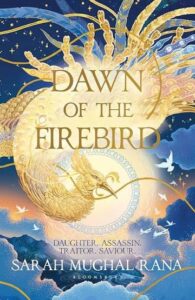
Dawn of the Firebird
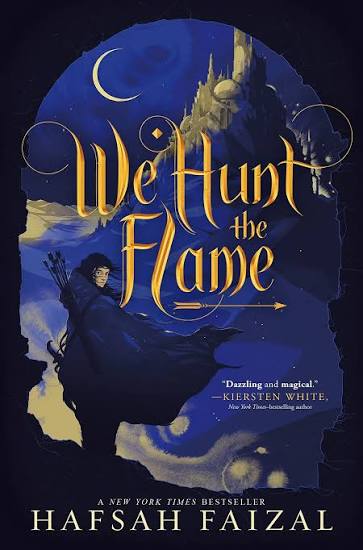
We Hunt the Flame